

HECT
Hagana Execution Control Theory
A governance-linked execution control doctrine designed to strengthen operational systems, enforce accountability, detect deviations in real time, and build institutional resilience across fragile and complex environments.
"A doctrine for controlling execution, enforcing decisions, and transforming operational variance into accountable institutional action."
Execution Control as an
Institutional Discipline.
HECT was developed from operational realities across humanitarian response, governance systems, institutional transformation, and fragile-context execution environments.
The doctrine connects strategy, accountability, operational visibility, adaptive response, and institutional resilience into a unified execution control architecture capable of functioning under complexity, uncertainty, and systemic pressure.
Execution First
Plans without controlled execution remain hypothetical.
Control & Accountability
Every action tracked. Every deviation detected.
Real-Time Adaptation
Sense changes earlier than the operating context shifts.
Systems Thinking
Impact emerges from how the parts function together.
Resilience by Design
Withstand shocks, pressure, and continued uncertainty.
Decision Enforcement
Decisions are mandatory; delay is operational failure.
The HECT
System.
A governance-linked execution control doctrine designed to strengthen operational systems, enforce accountability, detect deviations in real time, and build institutional resilience under pressure, uncertainty, and fragile realities.
- L.01Strategic Layer
- L.02Execution Layer
- L.03Monitoring Layer
- L.04Deviation Intelligence Layer
- L.05Decision Layer
- L.06Adaptive Response Layer
- L.07Institutional Learning Layer
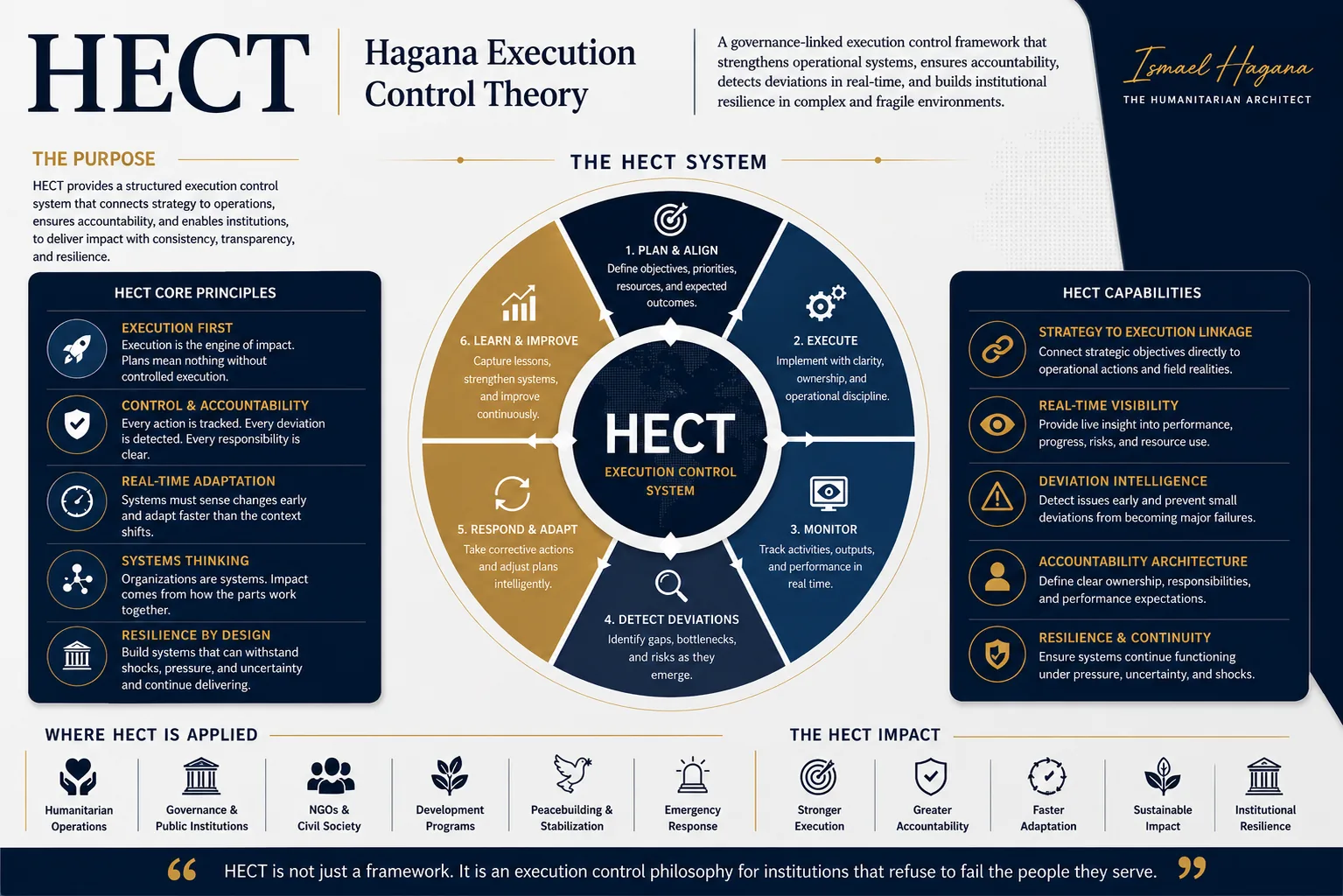
"Execution is not managed retrospectively.
Execution is controlled in real time through visibility, accountability, deviation intelligence, and enforced institutional response."
Where the doctrine
operates.
HECT is engineered for environments where execution must remain controlled despite pressure, complexity, fragmentation, and institutional fragility.
Humanitarian Operations
Execution control across crisis-affected populations and complex response environments.
Governance & Public Institutions
Strategy-to-execution alignment within state and public institutional systems.
NGOs & Civil Society
Operational accountability, performance discipline, and institutional traceability.
Development Programs
Long-horizon delivery under shifting political, financial, and operational realities.
Peacebuilding & Stabilization
Coherent execution across fragile, contested, and post-conflict environments.
Emergency Response
Rapid, decision-enforced execution where delay translates into systemic failure.
"Execution without control creates institutional blindness.
Accountability without visibility creates operational illusion."
HECT is not a reporting framework. It is an execution control doctrine for institutions operating under pressure, complexity, and fragile realities.

“From conviction to controlled execution.”